Pages

The Well-Fed Network Food Blog Awards 2006!

Yes, it's that time of the year again...blog awards! The Well-Fed Network are graciously hosting the awards this time around so if anyone knows of a food blog that is deserving of an award (for example, Writing At The Kitchen Table...), follow this link and express your devotion to that blog!
http://www.wellfed.net/
I have a few ideas of my own for worthy blogs (that don't include my own) and I feel that it's good to support the smaller and newer sites too.
Happy Voting!
reade more... Résuméabuiyad

Two Rustic Dishes

As the title says, two rustic meals: the Main Course from France, the Dessert English, both simple and outstanding.
You may recall that I bought some salt cure from the Sausage Making.org recently. Whilst my beef is still curing (three days left and counting!), the real reason I had bought the cure was for a recipe I fell madly in love with: Petit Sales Au Lentilles. I first saw this on Rick Stein’s French Odyssey (and I promise, no more Stein recipes for at least the duration of this year!). Actually, what Rick Stein achieved with his show was something that very few TV chefs have: a comprehensive and interesting culinary tour of France. It is currently the norm to do the Italian thing and the once uber-important French cuisine has been pushed by the wayside.
I think that the main reason us Brits at least have withdrawn from French food is because of its seeming complexity. I remember as a child reading Cordon Bleu cookbooks that my mother had been given as wedding presents and being amazed at the intricacy of the dishes. I was also a little bit awed and more than a little bit scared by the use of aspic and carrots cut into diamond shapes.
In fact, this kind of intimidating cuisine is rarely seen outside of expensive restaurants.
I enjoy food that is simple but tasty. I have mentioned on many occasions that I love Cabbage Stuffed in the Troo Style (a French way of cooking cabbage and sausage, using just those two ingredients and judicious seasoning), a basic dish that is not glamorous, it doesn’t scream ‘eat me!’ when you look at it yet it fulfils and simultaneously sooths the appetite in the same way that our mothers Shepherds Pie used to.
These simple rustic dishes utilise the most basic of flavours to make them key players in the final dish: carrots, baby onions, the omnipresent bouquet garni, celery, sea salt. All of these ingredients are quintessential to a great rustic dish. Add a cheap cut of meat, in the instance of Petit Sale au Lentilles, Belly Pork, and the recipe virtually cooks itself.
I had reservations about the success of the dish: would it be too watery, too bland? Was the meat going to be tough? Should I cook some potatoes as ‘filler’, just in case? In fact, everything was perfect.
Let me elaborate. The belly pork has to be salted for no more than four hours, hence the name Petit Sale, small salt or lightly salted. I awoke late so I only had two and a half hours of salty marinating allowed for my humble piece of belly pork.
Once the petit sales process is over, the pork is rinsed, simmered in plain old water for about forty five minutes, then Puy Lentils, Carrots, Baby Onions, Celery and Herbs are added. Once cooked, it is enriched with a knob of butter and some freshly chopped parsley. The lentils ensure that the broth is thick, the vegetables and herbs give the dish its flavour, along with the slightly salty pork (I didn’t salt the dish at any point during or after cooking), the meat was tender and the potatoes were too much!
Dished up, it looks beautiful, like a Van Gogh painting, all bold and chunky. I served it with some simple boiled Savoy Cabbage, and Sautee Potatoes (which were more than a slight case of culinary overkill) and everybody commented on the flavour of the pork. The brief curing procedure had not produced a salty meat but a richly flavoured meat. My husband noted that this was the type of dish he would like to be served at a restaurant but knows he would never see it on a menu because of it's unassuming demeanour.

As a side note, I cannot recommend the usage of brining or curing too highly (on special occasions). Fish will be my next experiment.
For dessert, I wanted something light and cleansing. I was thinking of the acidity of lemons. I remembered seeing a recipe for a Lemon Posset and being curious. After all, how exciting can a dessert comprising of double cream and sugar be? Ahh, well in fact it can be just as exciting as a chocolate mousse or a chestnut gateaux, for surprise of surprises, the two ingredients cooked together form a dense cream, thicker and richer than Clotted Cream, that is a perfect base for all manner of flavourings.
A Posset is a mediaeval dessert. Well, it had to be. The name alone evokes phantasmagorical images of maidens in tall pointy hats, wearing low brocade dresses strolling through orange gardens, playing mournful songs on a mandolin, flanked by five long legged Salukis.
So, perhaps my imagination is overly vivid, but the dessert is truly what fantasies are made of.

In fact, a Posset is a Middle Age concoction, whereby hot milk was curdled by adding wine. It was then drank as a curative rather than for pleasure. The Posset was so popular that Posset Tea Sets were commonplace in the homes of the upper-class, a Posset being taken before bed to aid sleep (much the same as a hot drink before bed today). As time went on, the posset became far more palatable: mulled wine, nutmeg, cinnamon and mace were added as flavourings, with eggs and sugar used as thickeners, the most famous of which, The Sack Posset, is noted by Samuel Pepys in his diaries.
PETIT SALES AU LENTILLES (taken from Rick Stein’s French Odyssey) Serves 3
Ingredients:
1kg Piece Belly Pork, preferably not rolled but if like mine it is, gently flatten it out, so it resembles a rack of ribs. Rind still on.
200g Sea Salt mixed with 1 gram of Salt Cure (other brands may require more or less per weight of meat so check the instructions carefully). Traditional French Rustic Dish aside, I was rather loath to use all my Maldon Salt and then throw it away, so I used 75g Sea Salt and made the rest up with regular granulated table salt.
6 Small Carrots, halved
15 Baby Onions, or as many as you like/have the strength of eyes to peel
3 Sticks Celery, peeled with a vegetable peeler and cut into 3cm chunks
300g Puy Lentils
Bouquet Garni comprising two bay leaves, some sprigs parsley, thyme and rosemary
15g Unsalted Butter
More Parsley, this time chopped
METHOD:
Four hours before you intend to cook the dish (so, about 6 hours before you intend to serve it), salt the pork. Place it in a non-metallic shallow baking dish. Pour over half the salt mix, rub well into the pork. Turn the meat over and massage in the remaining salt. Cover with clingfilm and refrigerate for four hours.
After the four hours, rinse the salt from the pork. Place in a deep saucepan (I used a sauté pan) or heatproof casserole dish (which looks nice when you carry it to the table) and cover with about 1 litre of water. Bring to the boil removing any scum that rises to the surface. This is just the protein and any remaining salt discharging itself from its porky dwelling.
Turn down to a simmer, cover and cook for about 30-45 minutes.
Now gently stir in the greenish/black, pebble-like tiny puy lentils. Add the Bouquet Garni.
Leave to simmer for 15 minutes whilst you prepare the vegetables.
Now add the vegetables and cook until tender. Depending on the size of the carrots, this could be anything between 20 minutes to another 40.
Gently remove the pork and cut, lengthwise, into thick, generous slabs.
Add the butter and parsley to the lentils and vegetables and stir through. Pour into deep, wide bowls or onto plates, top with the pork pieces. Serve with some plainly cooked cabbage.
n.b. The original recipe called for smoked sausage to be added to the dish. I was unable to get hold of any in time but please feel free to add some, cut into chunks, with the vegetables.

LEMON POSSET: Serves 3
Ingredients:
284ml Double Cream
100g Vanilla Caster Sugar (if you don’t have vanilla caster sugar, add half a teaspoon of vanilla extract when you remove from the heat)
Juice of 1 Lemon
METHOD:
Heat the cream and sugar in a large saucepan. Boil for three minutes.
Remove from the heat and quickly stir in the lemon juice and vanilla extract (if using). The cream will thicken as you add the lemon.
Strain into a jug (to remove any skin that the hot cream might have produced) and pour into ramekins. Chill for at least six hours. I chilled them overnight.
They will set to an incredibly firm but creamy texture and taste perfectly tangy. Serve with some butter biscuits or fresh raspberries. Dust with icing sugar if you’re feeling particularly high-falutin’.
Close your eyes and enjoy...
reade more... Résuméabuiyad

Ravioli

Last week was far from satisfactory, culinary wise, but I have many more dining cards up my sleeve. Last night, Friday, was spent in an outrageous flurry of kitchen activity that ranged from steeping fruit in alcohol (for the Christmas pudding being made today) to making our own ravioli. In between all of that, I managed to also make Lemon Possets with Almond and Orange Florentines.
I'm not bragging. With the exception of the ravioli - always a fiddly task at the best of times - everything else was so easy that they barely deserve writing about. Which means that, of course, I will be writing about them!
For now though, I am going to write about the ravioli. You may have read on previous posts that I was planning on making ravioli with a pumpkin and amaretti filling. I recently saw this recipe on a rerun of Rick Stein's Food Heroes and it seems that he is my current food hero. I enjoy his non-cheffy approach to food and his ability to make complex dishes seem attainable in the home kitchen.
Ravioli filled with Pumpkin and Amaretti is a traditional Italian dish. You can rely on the Italians to discover an amazing flavour combination whilst us Brits still think that ham and pineapple is exotic.
I used butternut squash instead of pumpkin. Firstly because pumpkin is difficult to obtain here apart from a few weeks in October, and secondly because I find it easier to work with, lastly because the quantity of "meat" in a squash is more appropriate for a small family. When you consider the pumpkin squash as a vegetable, it has a sweet, slightly nutty taste that lends itself to both savoury and sweet dishes. I love the combination of salty/sweet together (my favourite snacks as a teenager were french fries dipped into chocolate milkshake and kitkat bars with ready salted crisps) so the idea of throwing amaretti - a heady, marzipan-type flavour - into the mix, had me seduced as soon as I saw it.
Making the pasta itself is relatively easy if you are the patient type. I am not at all patient but I have never made pasta before (previously only being allowed to serve as sous chef while Paul accepted the praise for the finished product) so felt it was time to start. In fact, I made the dough (an incredibly eggy-rich dough: 2 whole eggs and 4 yolks) on Thursday night because I believe that any dough benefits from resting in the refrigerater overnight. It also becomes infinitely more handleable. The kneading of dough is where my problems with patience come into being. 10 minutes of kneading is quite torturous for me: "Are 10 minutes up yet?" Paul: "No. Keep Kneading".
Friday night Paul eventually locates our pasta maker (which had been relegated to the basement when we moved), dusted it off and set it up on the counter. He started to roll the dough through the machine and as it became thinner it also began to resemble an old mans's string vest. However, this simply indicates that the dough wasn't kneaded for long enough ("are 10 minutes up yet?"). As you continue to feed it through the rollers, the gluten starts doing it's job and it starts to cohere.
After adjusting the rollers thinner and thinner, you are eventually left with smooth, even pasta that resembles parchment but is actually quite strong and elastic-y.
We wanted to use the ravioli tray that came free with the pasta maker and make some freehand ravioli too. I felt that the freehand approach was far safer than the tray, which we had already had one major disaster with (we didn't flour the tray before placing the bottom layer of pasta over it - it was a pasta massacre).
It is a constant source of irritation when people don't give you all the information. To use a ravioli tray, you must fill each tiny square with flour before you even think about placing the pasta sheet on it. I only know this because I saw – it wasn’t mentioned – someone do this on a cookery show. In fact, it is of paramount importance that you keep your pasta, once rolled out, floured at all times, otherwise it can stick to everything.
Anyway, he used the tray, I used small scone cutters. Mine was the slower but inevitably more successful method of preparing the ravioli. Little tiny flying saucers filled with the hauntingly unusual almond/squash filling, emboldened by the butch sage butter. It is a recipe that is well worth the effort.
PUMPKIN AND AMARETTI RAVIOLI WITH SAGE BUTTER
Ingredients:
Pasta:
225g Plain Flour
¼ teaspoon Salt
½ teaspoon Olive Oil
2 Medium Eggs
4 Medium Egg Yolks
Filling:
450g cooked Pumpkin or 1 Butternut Squash. Cut into large chunks, scoop out any seeds, drizzle with a little oil and roast at 200c for 45 mins or until tender
1 Egg Yolk
25g grated Parmesan
Grating of Nutmeg
2 crushed Amaretti Biscuits
15g White Breadcrumbs
Salt and Pepper
Sage Butter:
75g Butter
20 Sage Leaves
Lemon Juice
METHOD:
To make the dough for the pasta, mix all the pasta ingredients in a bowl or food processor and blend until they come together into a ball.
Knead the dough on a floured work surface for 10 minutes. Wrap in cling film and leave to rest for 10 - 15 minutes. (Dough can be prepared in advance and left in the refrigerator in cling film. Remove an hour before preparation and allow to come to room temperature.)

Allow the pumpkin or squash to cool enough to handle. Remove the flesh from the shell. In a bowl, use a fork to mash the flesh of the pumpkin/squash adding. Stir in all the remaining filling ingredients and season to taste. Mix well.

By hand, roll the pasta dough to about 10mm thick. Then feed through a floured pasta machine on the largest setting several times folding pasta back on itself before each pass. When dough is smooth and easy to work, adjust setting down a notch and feed through once. Continue until you have reached setting 5.
Place half the pasta sheet on a floured work surface and evenly space spoonfuls of the filling on the sheet. The size and amount is dependent on how large you want your ravioli to be.
Brush water between pockets of filling.
Place the remaining sheet of dough over the top and press firmly around the pockets of filling forcing out as much air as possible.
Cut between the ravioli with a knife, pasta wheel, or a round scone cutter. The quantity you make will be determined by the size of the ravioli.
Cook them for four minutes. Drain and pour into a serving bowl.
For the sage butter, melt the butter in a large frying pan until foaming, throw in the sage and fry for a few seconds. Remove the pan from the heat and add the lemon juice and some salt and pepper to taste.
Pour the sage butter over the ravioli, with some grated parmesan cheese liked.
Serve immediately.

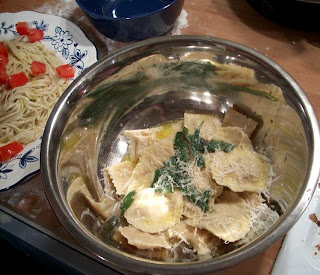
Note: If you have any pasta remaining, you can do as we did. Feed it through the vermicelli cutter on your pasta machine. Boil until al dente and drain. Place pasta on a plate and drizzle with olive oil. Chop a vine tomato into 1cm cubes and put on top. Grind a pinch of sea salt between your fingers over the tomato adding more if you like. Add fresh ground black pepper to taste. Simple and delicious! This makes an appearance in the picture above.
reade more... Résuméabuiyad

A Disastrous Meal

I have been less than enamoured with much of the food that I’ve cooked this week, with the exception of the salt beef (although only time and tasting will tell). Sometimes you get weeks like that. You feel all discombobulated, out of sorts if you will and it will reflect in your cooking if you let it.
I had a completely disastrous experience with a pair of aubergines and a recipe that I culled from www.uktvfood.co.uk website. Let me elaborate. Regular readers may recall that I had an aubergine in my fridge a couple of weeks back, which I turned into a delicious vegetarian chilli (recipe courtesy of the same, aforementioned UKTV site). This time, however, I was looking to make something a bit different, maybe involving pastry and cheese. I found a recipe, Sephardi Aubergine Pies. It seemed to fulfil my every requirement for a new dish: an interesting pastry (made with olive oil instead of butter/lard), stuffed with a yummy sounding filling (roast aubergine, feta and gruyere cheese mixed with Za’atar), turned into darling little pasties and baked. Perfetto!
Actually, not perfetto. The dough was easy enough to prepare, beating together olive oil with some water and the flour. It formed a firm dough that didn’t require lengthy refrigeration to render it usable, thereby ensuring full stomachs, quicker. The aubergines needed charring over a gas hotplate which we don’t have so I shoved them under a scorchingly hot grill instead and watched them like a fearful mother hawk as their purple lustre turned to blackened wrinkliness, like giant prunes. I devotedly peeled every scrap of the black skin from those burning hot eggplants, and enjoyed the weetabix-type smell that they gave out. I mixed them with the two cheeses, carefully added a sprinkling of the za’atar and got to work on the pastry. This is where it all turns to ruins.
The pastry is incredibly dry, dryer than the skin on an opened tin of gloss paint that’s been left out in the sun. I add water and then some oil. This makes the dough more workable but then it sticks to the work surface, despite me flouring it.
So, I manage to make about 10 little circles. I am feeling extremely dubious by now because I can see how the dough is drying out and cracking before my eyes. I carry out regardless. I am not about to waste my aubergines! I spoon the mixture into the centre of each circle. I attempt to fold the pastry up into a purse shape, as per the recipe. This absolutely does not work. The pastry is crumbling around my fingertips. I try another way. Folding them in half, like English pasties. They crack and break up. If there is one thing that irritates me more than anything, it’s an incorrect recipe or one that doesn’t tell you how to rescue a disaster!
My husband, creeping into the kitchen tentatively, wondering what all the cries of anguish are, saves the day. He suggests I cook them as they are: open topped. I weep gratefully and slam them in the oven. Meanwhile, he gently suggests that perhaps he should make cannelini beans with chorizo, just as a side dish you understand. I nod.
10 minutes later, the aubergine saucers are ready. The pastry looks dry, brittle and dull.
Still, my husband dishes up his beautious canellini bean dish and I arrange my little open topped pasties alongside. We bite into them. Paul politely eats them although he gives the pastry to the dogs. Even they don’t like it. The topping tastes fusty and stale. The Za’atar is much too pungent the delicate aubergine and cheese mixture and overpowers everything.
Still, the cannelini beans are good. As was the Fig and Honey Ice Cream I had for dessert.
I am consoling myself with the knowledge that I have a ball of egg pasta that I made (for the first time!) in the fridge, chilling down for me to turn it into squash and amaretti biscuit ravioli tonight and two little partridge waiting for the perfect recipe. I am also making lemon possets for dessert tomorrow. The weekend looks culinarily optimistic. I shall keep you posted.
reade more... Résuméabuiyad

BBM - Blogging By Mail Seasonal Edition

Stephanie at The Happy Sorceress Blogspot has devoted much of her time to arranging a seasonal swap. I received mine yesterday from Cass at Cass Loves Cooking from Singapore. Here is a photo of the great things that she sent me - a wonderful surprise for these horrible grey, damp winter days! She sent, amongst lots of other things, some cured salami-type sausages, noodles, dried mushrooms (which I'm really looking forward to using) and some sweets (that my husband snaffled straight away!) all wrapped up in Christmassy Tartan!Thanks to Cass and Stephanie and I look forward to participating in many more BBMs in the future!
reade more... Résuméabuiyad

Partridge - A Game Bird


I am not here to get embroiled in an anti-hunting argument. I spent much of my youth fighting the side of the animals. As a now grown-up ‘food person’, I think it is important to experience as many different things as you can. With the benefit of experience and a slightly more logical view of the world than I had when I was fourteen, I think to be given a brace of game birds is a real gift rather than a dirty little secret. I grew up living next to a farm so I am used to hearing the familiar sounds of the fox hunters (which I am opposed to) and to the shots that accompany the short season of game hunting. Whilst I cannot see the pleasure in shooting any bird or animal, my justification for eating the cull of a shoot is this: the birds have lived an entirely free range life. Once they reach a sort of maturity (feathers still a bit rough looking but fully grown), partridges and pheasants are released from the comfort and security of their holding pens into the wild where they begin to fend for themselves. Drive along any country road in Essex and you will experience the slalom of avoiding pheasants and partridges darting across the road, as surely as if they were kamikaze pilots, dive bombing the enemy. The only difference being, the birds don’t actually want to kill anyone, they just have zero road sense.
The point I’m trying to put across is that game birds, that are eventually shot and eaten, are really no different to chickens (whether organic or battery) that are slaughtered and then eaten. If you are a meat eater you must be prepared to accept this fact. The only difference is that chickens come ready drawn and plucked whereas game birds are uneviscerated and fluffy.
I was recently given a brace of partridge from a shoot held near where I grew up. My mum had them hanging up in her garage and every time she walked past them she shuddered and said “I don’t like to see them.” I, on the other hand, was thrilled although less enamoured with the idea of plucking and gutting.
When I was a child and we didn’t have much money, the local farmer would give us pheasants and partridges (back then, they weren’t quite as popular as they are now). I remember standing on a stool at the draining board with my mum and we would clean them bald of their once resplendent feathers, so resonant of autumn. My favourite job was pulling out the entrails - a gory little thing I was - and I would enjoy pulling the tendons in the neck to make the feet twitch. Back then I didn’t realise that everything should be allowed a certain degree of dignity, even in death.
Anyway, at some point, my mother got a bit squeamish about pheasant and game in general, and we stopped eating them. She is certain that the older you get, the fussier you get but I am railing hard against this factually unsound statement. After all, this year alone I have overcome several food phobias of my own – lamb, raw tomatoes, fish roe, dried fruit and chicken livers (although, I have yet to actually eat the livers). I am still unable to drink milk though. We’ll save that mountain of achievement for next year.
So, our two partridges. There they hang, all sunken eyed and ruffled feathers, their feet still bearing the mud and grass that they would have mulched around in whilst alive. I feel terribly sad as I look at them but then I am overcome by the same feeling that my forbearers would have had: to make use of what the land provides us with. Nature doesn’t endow us with food neatly packaged and trussed and clean and pink: someone has to prepare this for us. The two partridges that hang before me are what we eat everyday but in their most natural form.
Of course, I am unable to prepare them. My husband, the ex-nurse, is always up for a challenge. He reminds me that when he was at medical school, he would go and eat fried chicken straight after human anatomy. I eyeball him curiously as he whips out the gore from the plucked partridges. They have been hanging for six days. The smell is pungent and gaseous. I haven’t smelt that smell since I was a gleeful child eviscerating pheasants but I recognise it instantly. We throw the organ meat onto the fire with the dogs snapping at our feet: “me, me!” It must smell unbearably good to them, wild beasties that they are.
My mum rinses them under the sink. She has betrayed her previous promise that she would never touch them again and helped Paul to pluck them. She is far quicker than him.
I put them, cold, pink and pimply from the water and the plucking, on a plate and truss them gently. Naked, they are tiny little birds, enough meat there on the plate only for two.
I am buoyed with enthusiasm following the Guinea Fowl that I ate at the weekend so I am looking forward to cooking the partridge. I will freeze them for now though until I have found a recipe that is deserving of them - those tiny birds who lived their lives as all animals should: in freedom.
reade more... Résuméabuiyad

Dough, a Beer....


I decided this week that I didn't feel like staying up past my bedtime waiting for bread to come out of the oven. I waited until Freya went to the basement for some ingredients and made my move on the kitchen. My incursion was much better executed than the Roman invasion of the Teutoburg Forest and far more dangerous. Knowing only seconds stood between success and failure, I chose to make the easiest bread in the world, Beer Bread.

As is the case with all my cooking experience, there's a funny story attached to my introduction to beer bread. I was living in Denver at the time and preparing to celebrate my 25th birthday. I decided to throw a big party and thought it best to get a keg for the event. I'm very picky about beer and this applies to beer in barrels as well as bottles, so I spent big on a full keg of Heineken. I made up my own invitations, cleaned the house, and made up a big vat of gumbo (I should probably write a post about this, one of our all-time favourite foods...eventually). The big moment arrived and passed, but finally the doorbell rang and two people walked in. We drank some beer and ate some gumbo and waited. It became apparent that nobody else was going to show up. I knew there was an explanation because EVERYBODY LOVES ME, don't they? My friend Rocky later told me that everybody thought the invitations were a joke. For future reference, invites should not resemble a punk fanzine.

The next day I was left with a serious dilemma. The keg and tap were on a deposit. If I didn't return them before the end of the weekend I would lose $30. Hey, thirty bucks is thirty bucks, right? As I wasn't up to the challenge of drinking all that beer, and surprisingly neither was Rocky, I had to come up with a solution. My neighbors Skip and Mark (the only two people at the party incidentally) suggested I make beer bread. "Great!", I said, "What do I need?" I headed out to Albertson's and bought twenty bags of self-rising flour and a couple of bags of sugar. Mark came over and we set up a bread making assembly line. I poured ingredients into bowls and mixed them up, Mark turned the dough out onto baking sheets and dusted the tops with flour. The flour on top was needed he claimed to make them "Faabulouss!" We made nearly eighty loaves of bread in just under six hours and while the people who didn't show up for my party weren't deserving, they all got a loaf.

I introduced my mother-in-law to beer bread a few years ago. For the following week I was induced to make several loaves for her work colleagues. It was at this point that I discovered the versatility of the bread. Add some cinnamon, extra sugar, and raisins for a nice sweet variety. Add some olives and cheese for something savoury. If you're not too adventurous it's easy to achieve a variety of results just by using different types of beer. I have tried this bread with a lot of beers, but I find it's best with either a very cheap lager or a bottle of Guinness.

BEER BREAD
Ingredients
3+/- cups self-raising flour
12oz. beer (I used Fiddler's Elbow by Wychwood this time)
2 tablespoons sugar (4 if you're using brown sugar)
1 teaspoon salt

METHOD
(This is the simple part! No kneading, no proving.)
1. Mix all ingredients in a bowl until a loose dough forms. The looser the dough the lighter the bread will be, but don't blame me when it expands to fill your entire oven. If you want a denser loaf just add more flour.
2. Place dough on a floured baking sheet, pizza stone, or in a bread pan. Put straight into a preheated oven (400°F/200°C) and bake for 30-40 minutes dependent on thickness of the dough.
3. Allow to cool to room temperature before slicing. Great served with butter and jam!
You will notice that I have omitted the sprinkling of flour on top, but I don't require my bread to be Fabulous. Feel free to add it back though if you're so inclined.

Enjoy!
reade more... Résuméabuiyad